
Homemade Cranberry Sauce Is Easy!
Cranberries grow in bogs. Bogs are like swamps. I’ve always had a thing for bogs and swamps. Did you know all that?
For a while after college, I considered going to graduate school to study either parasitic plants or bogs and swamps. I got my bachelor’s degree in botany and really, with a degree like that, one has to go higher if one wants to ever use all the fun facts one learned in college. But also, I had absolutely no idea what to do next. More school seemed like a great way to put off the problem.
Unfortunately, procrastinating real life is not a great motivator.
I only applied to one school, and spent about five minutes on my application essay. It went something like this:
I would like to study parasitic plants. Parasitic plants are real cool and there’s not a lot of people studying them. I also like bogs and swamps.
I’m not shitting you. It was that awesome.
I didn’t get in. Instead, I ended up going to work for my mom and here, over 10 years later, I still am. Woe is me.
But anyway, back to the cranberries that live in the bogs.
Cranberries are native to North America and related to blueberries and huckleberries, which sound like a made-up berry but actually are real. Bogs are the super-acidic, freshwater wetlands where cranberries grow, as well as many super-specialized, carnivorous plants like pitcher plants, sundews, and “Audrey II” from Little Shop of Horrors. (Feed me, Seymour!) Being a bog also means being in a cold climate. I’m pretty sure that’s the big difference between bogs and swamps — cold versus hot — but don’t quote me on that.
Cranberries were introduced to European settlers in the New World by Native Americans who’d been grubbing on cranberries for a long time. They are chock-full of antioxidants and probably saved more than a few people from dying of scurvy. Because they ripen in the fall, they cranberry has become synonymous with Thanksgiving celebrations throughout North America, and by that I mean even Canada! Dang!
While the can-shaped, jellied-cranberry-sauce-log certainly still has it’s place (usually sliced and fanned out on a plate with a parsley sprig) homemade cranberry sauce is another thing entirely.
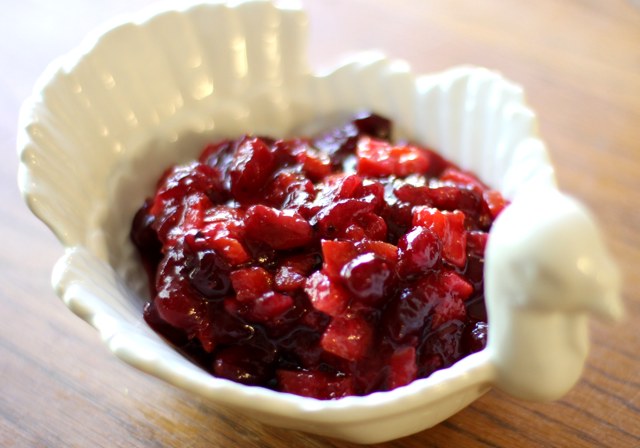
It’s gorgeous. Like a bowlful of garnets, it’s so sparkling you may be able to get away with using it as the table centerpiece. It’s complex. More of the natural tartness of cranberries combined with the warmth of orange oils and cardamom make for a relish worthy of your great, grand turkey. It’s easy. Perhaps not quite as easy as opening a can, but nearly so, and the extra beauty and flavor you get from it makes it worth the extra five minutes of your time. Really.
Homemade Cranberry Sauce Video
Homemade Cranberry Sauce Recipe
PrintCranberry Sauce
Homemade cranberry sauce made from fresh cranberries
- Yield: 8-12 1x
Ingredients
- 1 pound fresh or frozen cranberries
- 1 large seedless orange, scrubbed well
- 1 cup sugar
- 1 teaspoon cardamom seeds, lightly crushed (from about 10 whole pods)
- 1/2 cup water
Instructions
- Dice the orange, skin and all.
- Combine all ingredients in a sauce pan and stir to combine.
- Cover and put over high heat until it boils.
- Remove lid and cook for 5 minutes more, stirring frequently, until berries are popped and the liquid has thickened.
- Cool completely in the refrigerator before serving.
Bonus Recipe: Uncooked Cranberry Relish!
You don’t have to even cook this! If you want less of a jelly-like sauce and more of a salad-like relish, you could also just throw everything in a food processor, minus the water, and whizz it around until it’s all finely chopped. Refrigerate a couple hours for the flavors to blend.
34 Comments
Leave a Comment






Awesome, I’m definitely going to make this next week. Super easy, and way better for you than that stuff that plops out of a can, I would imagine.
Deeeelicious. I’m going to make it and was thinking you could use kumquats or calamondin oranges if you are really brave. might need alittle sweetner if you use either of those. Thanks O! Wise One for the recipe.
Oh Penel, you’re a food-genius! Kumquats would take this over the top! And if you just sliced them they would look so pretty, too. Thank you!
Oh crap, I just came back from the store. Wish I had read this comment before I went, kumquats would be delis in this! I love making cranberry sauce or relish for Thanksgiving, and am really excited to try yours. I’ve made it with orange lots of times, but never with cardamom. Mmm 🙂 Happy Thanksgiving Hilah! I’m thankful for you and for the inspiring recipes you share.
I hope you liked it, Veronika! And I hope your Thanksgiving was fun and delicious! Thank you for writing!
I’m making this again this year, it’s just so good. Thanks for all the great recipes Hilah, I am thankful for you 🙂
Thank you, Veronika. Have a happy Thanksgiving. I’m thankful for you, too.
i love your book and the videos so much! i wish your book was also available as a regular book, since it is sometimes a drag to scroll around in a pdf. however, i am willing to take these awesome recipes however i can get ’em!
thanks hilah!!
Hi Jessica! Thank you!
We are working on a print version, hopefully it won’t be much longer now.
By the power of Grey Skull!!! Oh man, I loved that. And the recipe looks tasty!
Thanks, Vic! I loved that dumb ol’ cartoon.
I’m a huge fan of homemade cranberry sauce, and this one sounds yummy. Also, homemade applesauce with cranberries (wee bit of sugar, lemon zest, cinnamon) is the bomb for T-day breakfast. Just sayin’
Ohhh, hay-ell yeahhh, Diane! That sounds amaaazzzing.
Great recipe! I would recommend using an orange with a very thin rind (if possible) or another thin skinned citrus fruit, like a couple of tangerines or something. I had an abundance of it because mine was super thick (it was still good and I like the bitterness). Instead of water, and because I like booze, I used currant vodka. It turned out really well, and made my kitchen smell delicious! Thanks Hilah!
Omigod, Jackie! Currant vodka sounds fantastic! Tangerines would be super yummy, and someone else suggested kumquats which would also be great.
Thanks for the fresh ideas! Happy Thanksgiving!
An amazing sauce. I love it! And as Penel said, kumquats are great with cranberry sauce.
Thanks, Olivia! I’m so glad you liked it. I think next year I will try it with kumquats, too.
Oranges with the rinds on? Hilah, you just blew my mind! Next time there is an occasion for turkey I am going to try this recipe Love your show – it is delightful!
It’s so good, Heather! Plus, you get to keep all the antioxidants in the rind. Thank you! 🙂
This is super delicious. I made it last year for Thanksgiving and it was all gone in about 5 minutes, heh! Definitely going to make this again this year. Might even do it for Christmas too. Thanks Hilah! 🙂
Thanks, John! Maybe make a double batch this time. 🙂 Happy Thanksgiving!
Here is the batch I made from your recipe for Thanksgiving 2012.
Thanks, GSF! Happy Thanksgiving!
Do you have to use cardamon seeds? Can you use ground cardamon instead? (I can find this easily in my grocery store)
Hey Deb! You can totally use ground cardamom if that’s what you can find. Just use a half teaspoon. Happy Thanskgiving!
My Mom’s relish grinds 1 bag cranberries, 1 orange, 1 cup pecans or walnuts, 1 cup sugar. Then she starts raspberry Jell-O with the boiling water and adds the cranberry mixture. refrigerate, You get a gorgeous and delicious relish that is the bomb on leftover turkey sandwich. Now I need to try cardamom and maybe Kumquats.
Yum! Love the freshness of a raw cranberry relish. Thanks, Terry!
OMG…..got all teary watching you make this with the orange in the recipe. My gramma made it this way, although she ground everything together in her clamp-on the counter meat grinder! She’d be ~118 this year!
I make mine with a very similar recipe, but use burgundy wine insteadofwater. Maybe I’ll combine the two recipes, tell the family the Jesus turned the water into wine? ????
Ooh, orange and cardamom and wine cranberry sauce sounds completely delicious!
This combination turned out amazingly delicious!! I’m glad I made a double recipe, because we ate about 1/3 already!! I usually use Port, but had Sangria on hand, which I used in place of the water. So delicious….I might need to make more this weekend. Thank you!
Sangria! Of course! I know that cranberry sauce is amazing. Happy Thanksgiving!
Homemade cranberry sauce is so easy and so much better than canned. I have never done it with orange but after experimenting with some flavour combinations I totally agree that cardamom is really good in cranberry sauce.
I just made my third double batch of cranberry sauce since Thanksgiving. Yum, this is SO similar to my Gramma’s recipe, it’s hard to resist! This time, I canned most to enjoy into the new year. I used a dark red port instead of water, and added a few gluts of brandy. That’s for this incredible link to my childhood!!
Glugs of brandy (silly autocorrect).